Saturday, April 7, 2018

Young Adult (Realistic) Fiction Annotation - Orbiting Jupiter


Orbiting Jupiter – Gary D. Schmidt

Basic Info:
Genre: Young Adult Realistic Fiction
Publication Date: October 6, 2015 (hardcover)
Number of Pages: 183
Geographic Setting: Rural Maine
Time Period: Current
Series: None

Plot Summary:
Joseph Brooks has only truly known love once in his 14 years. That was before he was sent to juvenile where he tried to kill a teacher, and before he was incarcerated at Stone Mountain. When he is placed with a foster family in rural Maine, he slowly opens up to his foster brother, Jack, and Jack’s parents. They learn that Joseph’s one true love was Maddy and that he is the father of a baby named Jupiter. Joseph wants nothing more in life than to be a father to Jupiter. After careful contemplation, his foster parents are willing to help him find her, but he has obstacles to overcome: the court system, and his drunk, abusive father who will reappear and change the course of everything.

Characteristics of Young Adult Realistic Fiction
Pacing: Shorter chapters and a quickly unfolding story line make for a faster pace.  
Characterization: The main characters (Joseph and Jack) are believable and likeable. While Joseph originally seems quiet and somewhat menacing, the reader soon learns that he is scared, heartbroken and very intelligent. While fatherhood is not a typical problem that young teen boys experience, it does happen and this book does not “devalue or minimize” this issue that some teen boys face (Cataldi, 2018.)
Tone: The story is emotionally intense with readers experiencing Joseph’s emotions vacillating between heartbreak and hope.

Readers May Also Enjoy (Fiction):
Hanging on to Max – Margaret Bechard
Both novels are young adult realistic fiction dealing with teenage fathers who choose to raise their baby in the absence of the baby’s mother.
Mahalia – Joanne HornimanBoth novels have authentic characters who are not only experiencing coming-of-age issues, but also the travails of being a teenage father raising a child on his own. While “Jupiter” is faster-paced, “Mahalia” unfolds at a more leisurely pace. 

Work Cited
Cataldi, E. (2018, April 02). Readers' Advisory - Week 13. Retrieved April 08, 2018, from http://readersadvisoryblog.blogspot.com/2018/04/week-thirteen.html


Sunday, April 1, 2018

Literary Fiction Annotation - An American Marriage


Basic Info:
An American Marriage – Tayari Jones
Genre: Literary Fiction
Publication Date: 2018
Number of Pages: 306, hardcover
Geographic Setting: Eloe, LA and Atlanta, GA
Time Period: Current
Series: None

Plot Summary:
  
Celestial is a headstrong, ambitious artist from Atlanta, GA. Roy is a successful, self-made business man from Eloe, LA.  After being married just over a year, Roy and Celestial’s marriage isn’t perfect, but as Roy says, “One year in and the fire was still burning hot blue.”

While on a trip to visit Roy’s parents, Celestial and Roy stay at a hotel where they are woken abruptly, pulled into the parking lot, and Roy is accused, and convicted of a crime that his friends and family know he did not commit. Regardless, he is sentenced to prison for 12 years.

While Roy serves time, he and Celestial grow apart and eventually, Roy ceases all contact with her. Yet, Celestial does not file for divorce, continues to add money to his commissary account, and prods her Uncle Banks (Roy’s attorney), to continue fighting for an appeal.

When Uncle Banks finally gets Roy out 7 years early, Roy goes back to his home that he shared with Celestial and finds that she is seriously involved with Andre, her best friend from childhood, and the one who introduced she and Roy.

While Roy knows things have changed between he and Celestial, he knows that she stayed married to him all those years and his key still fits their home's door,  so he holds out hope. But after a confrontation in which Roy tries to chop down a meaningful tree in their yard, the couple wonders if it is too late to pick up the pieces and begin where they left off, or if they both have changed in ways that will make happiness again as a couple impossible.


Characteristics of Literary Fiction

Style/Language: The structure is more complex with chapters that alternate between various character perspectives.

Story Line: Per Saricks (2009), “Literary Fiction tends to deal with serious, provocative topics” and “presents a world in which there are no easy choices and no clear-cut good and evil” (181). While not the focus of the story, the conviction of an innocent black man is the catalyst for the story line.

Characterization: The reader experiences introspective, in-depth looks at the characters. The characters are “unique but always believable” (Saricks, 2009, p 180). The secondary characters, especially Andre, play a crucial role in the story.


Readers May Also Enjoy:

Upstate by Kalisha Buckhanon
Both novels focus on African American families torn apart by incarceration. While “An American Marriage" is told through regular prose and some letters, “Upstate” is completely epistolary.


Sing, Unburied, Sing by Jesmyn Ward
Both novels are character-driven and center on the lives of two different African American families dealing with the effects of incarceration and how lives are changed upon a loved one’s release.


Saricks, J. G. (2009). The readers advisory guide to genre fiction. Chicago: American Library Association.


Friday, March 30, 2018

Week 12 Prompt: RA Matrix for The Glass Castle


Where is the book on the narrative continuum?
Highly Narrative (reads like fiction)


What is the subject of the book?
A teen girl and her 3 siblings live in poverty with brilliant but irresponsible parents who believe that inventions, art, and alcohol are more important than food, electricity and running water.


What type of book is it?
Autobiography/Memoir


ARTICULATE APPEAL
What is the pacing of the book?
Quick-paced.  Short segments keep the book moving almost as much as the family physically moves from one location to the next.


Describe the characters of the book
The main character (author), Jeannette, is believable, introspective and witty. Her three siblings, Lori, Brian and Maureen, could be described similarly. They are much more responsible than their parents, Rex (an inventor) and Rose Mary (an artist), who are flawed, unreliable and quirky.

How does the story feel?
Darkly humorous, reflective, thought-provoking, hopeful.

What is the intent of the author?
To share the experience of her most unusual childhood.

What is the focus of the story?
How the author and her siblings survive a nomadic, (unnecessarily) poverty-stricken lifestyle with dysfunctional parents.

Does the language matter?
The story does not rely too much on the language. The language is not lyrical, but straightforward, matter-of-fact, and easily understood.


Is the setting important and well described?
Yes.


Are there details, and if so, what?
The story is full of details of the poverty-like conditions, such as caved in roofs, moldy walls, sleeping in beds made from cardboard, porches so rotted out that the family had to climb through the window to enter the house.

Are there sufficient charts and other graphic materials? Are they useful?
There are no charts or graphic materials included (at least not in the eBook version); however, if the author had a sketch of her father’s proposed “Glass Castle,” it would make a nice addition to the book.


Does the book stress moments of learning, understanding, or experience?
Learning from the father who was somewhat of a genius, understanding how to survive and rise above poverty, experiencing what it is like to be a child living in poverty.

Why would a reader enjoy this book (rank appeal)?
Narrative Content, Characterization, Learning/Experiencing


Thursday, March 29, 2018

New RA resource from NoveList

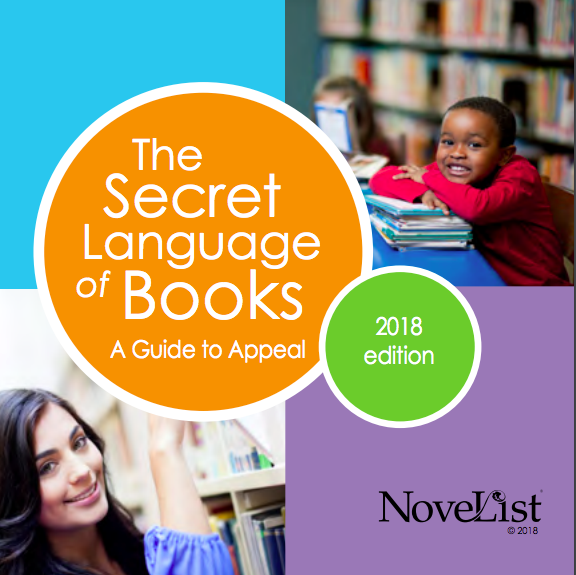
While poking around on NoveList today, I discovered this very cool new resource titled, "The Secret Language of Books: A Guide to Appeal, 2018 edition." It even has appeal terms for audio books! It's a handy little thing to keep nearby for those of us who work in a reference/readers' advisory position, especially if you frequently work in NoveList. I especially like the "Search Tips" section. 

https://www.ebscohost.com/novelist/idea-center/learn/learn-appeal


Sunday, March 25, 2018

A Few Thoughts on eBooks and Audiobooks


Despite being an avid fan of e-readers and working at a library for 2 years, I hadn’t really thought of how appeal terms would change for eBooks and audiobooks until this week’s readings.  I thought back to eBooks and audiobooks that I had not finished, and why, and recognized some of the issues that I had read about.

For example, one audiobook that I simply could NOT finish was “The Readers of Broken Wheel Recommend” by Katarina Bavald. The setting is Broken Wheel, Iowa. In the audiobook version, all the Iowan residents talk like Scarlett O’Hara (like they are from the Deep South.) I hung in there for an hour, but the accent misrepresentation was ultimately a deal breaker for me. “How well a narrator adopts different accents…is a necessary element to the audio book” (Mediatore, 2003). Out of curiosity, yesterday I checked audiofilemagazine.com to see what they thought of this audiobook. I was a little relieved to see that I was not alone in my thoughts. They agreed that the “…Iowan and other American accents don't quite ring true.” I did enjoy the story line – what little I heard of it – so I think I would have enjoyed this book had I started out reading rather than listening to it.

Music in an audiobook can be a nice surprise sometimes, breaking up the monotony of the narrator’s voice, but there are also times when the music becomes an annoyance. Neil Gaiman’s “The Graveyard Book,” has music at the beginning and at chapter breaks that goes on throughout the first few paragraphs of each section, and it is so loud that it is difficult to hear the narrator. This is not an issue one has when reading a hard copy or even an eBook.

Regarding eBooks, Dunneback’s (2011) article, “E-books and Readers’ Advisory,” Neal Wyatt notes that with eBooks, readers have “…the lack of physical indication as to how much left have of the book to read.” Readers who like to get through books quickly may experience frustration when they’ve “flipped” through 20-30 screens, and have not moved up at all in percentage of completion of book. I’ve experienced this (“Atlas Shrugged.”) This is one advantage that hardcopies have. When you’ve read for an hour, you can look at the top of the book, see where your bookmark is, and feel that pang of satisfaction that you’ve gained headway.

There are definitely things to consider when recommending audiobooks and eBooks to patrons, but honestly, in my year of working at the adult reference desk, I have not had any RA questions directly related to eBooks or audiobooks – most questions related to these types of media are TA – technology advisory. People want to know the “what’s” and “how-to’s” of digital media and the devices they use. Dunneback (2011) mentions factors that may affect a patron’s decision to ereaders over print materials. Some of these are “display options,” “touch screens,” “size and weight of the device,” and “large-type or text-to-speech capability.” In order to help patrons with these decisions, we hold a monthly “technology drop-in” session in which they may bring their devices or ask questions about any form of technology. We may not always have the answers right away, but we can always find them! We also hold a similar session closer to Christmas, but include examples of devices that patrons may be considering for Christmas gifts. Maybe once we get all the how-to’s out of the way and more patrons gravitate to digital media in our library, the RA questions will soon follow, and I will hopefully know the right questions to ask based on my learning!

REFERENCES
Dunneback, K., & Trott, B (2011). E-books and Readers' Advisory. Reference & User Services Quarterly, 50(4), 325-9. Retrieved from Library Lit & Full Text database. 

Mediatore, K. (2003) Reading with Your Ears: Readers' Advisory and Audio Books. Reference & User Services Quarterly, 42(4), 318-23. Retrieved from Library Lit & Inf Full Text database.

Photo Credit: https://www.barrons.com/articles/printed-books-enjoy-sales-growth-as-ebooks-hit-a-plateau-1429328543